The building and its history
Villa Rosa and its tiled façade
The history of Villa Rosa, now Tablao 1911, on Madrid's Plaza de Santa Ana: the 1911 opening, the tiled façade, Antonio Chacón and the 2022 new name.
Book your hour of flamenco ↗Quick answer
Villa Rosa is the former name of Tablao Flamenco 1911 at Plaza de Santa Ana 15 in Madrid. The tablao's own history says it opened in 1911 as a fried-food and tapas bar. Its tiled façade is credited to the Sevillian artist Alfonso Romero Mesa, though sources date the tiles anywhere from 1915 to 1927. The singer Antonio Chacón signed with the room in 1921, and the name changed in 2022.
Opened in 1911
The tablao's history page says the corner opened in 1911 as the Gran Colmado, an Andalusian fried-food and tapas bar run by three men from the bullring: the picadors Farfán and Céntimo and the banderillero Alvaradito. Spanish Wikipedia names the same three and calls the place a fried-food shop and tasca on the site of a former chocolate mill. The address is Plaza de Santa Ana 15, on the corner of Núñez de Arce and Álvarez Gato streets, which locals call the Callejón del Gato. Everything that follows grew from that corner shop. Spanish Wikipedia lists the address as Núñez de Arce 17, at the corner with the Callejón de Álvarez Gato, while the tablao and the tourism board use Plaza de Santa Ana 15, the address visitors use today.
The room as it was fitted out
The venue's own history says that in 1918 the premises became a restaurant (a casa de comidas). Spanish Wikipedia dates a remodelling to 1919, so the fit-out belongs to the late 1910s. The interior tiles show flamenco and bullfighting scenes and are credited to the Madrid ceramists of the Ruiz de Luna workshop and to Julián Santacruz. Madrid's tourism board says the panels have remained intact since they were made. Spanish Wikipedia describes the style as Arabic Andalusian and links the wooden counter and coffered ceiling to that remodelling, which gives the interior its look today.
The façade
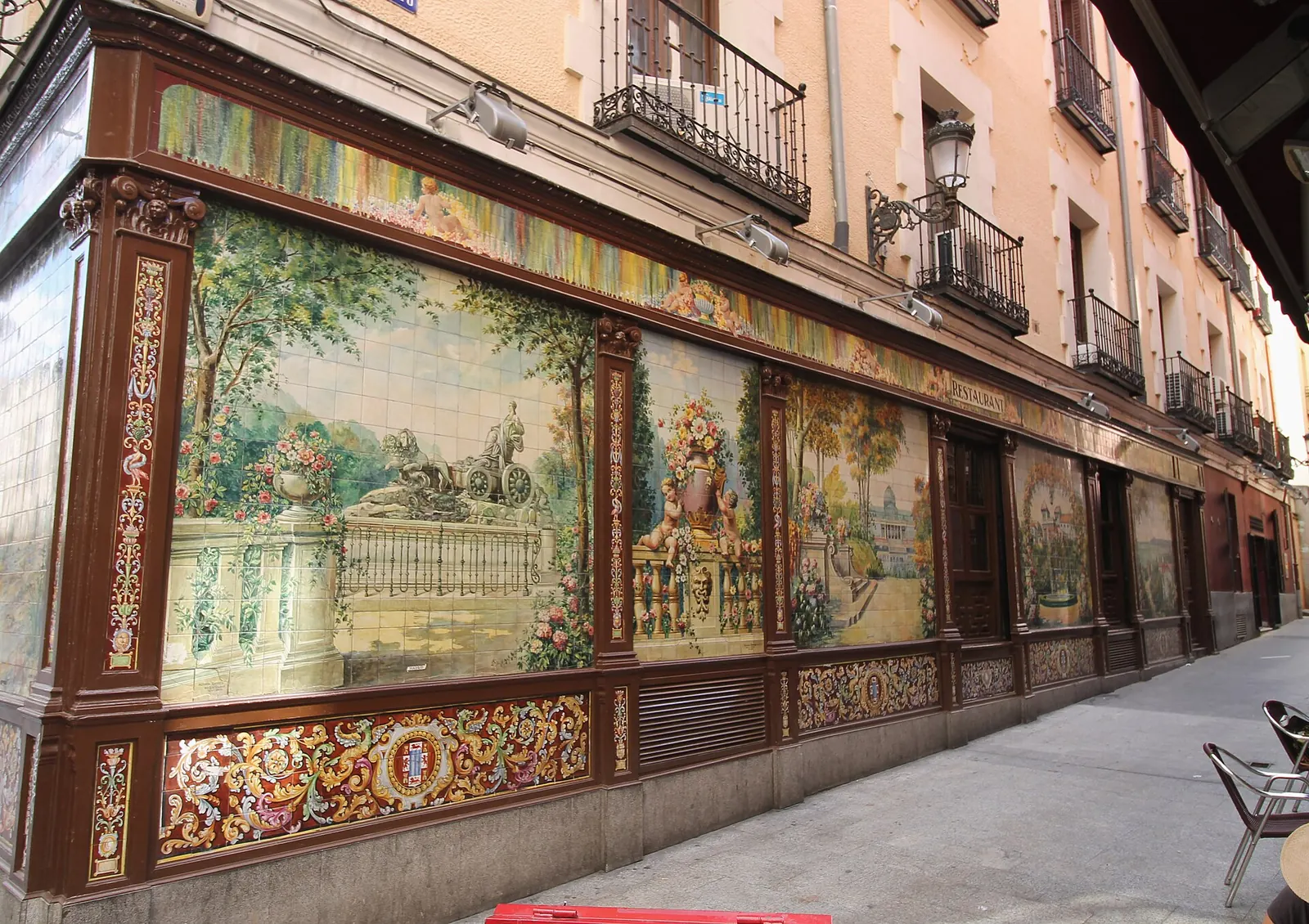
The outside is covered in painted ceramic panels and reliefs credited to the Sevillian artist Alfonso Romero Mesa, whom the tourism board also names as the maker of the tilework at Las Ventas bullring. The dates vary by source: the tablao's own site says the façade was completed in 1917. Madrid's tourism board and Spanish Wikipedia give 1927. A flamenco guide says the tiles were made between 1915 and 1920. Treat it as a façade of the 1910s or 1920s, and ask the venue if a single year matters. The sources agree on the artist and the subject. Spanish Wikipedia adds that the exterior panels were made from sketches by Juan Ruiz de Luna and describes eight landscape panels covering the front.
What the panels show
According to the venue, the exterior murals show Madrid's Plaza de Colón, Seville's Plaza de España, the Alhambra, Córdoba, Cibeles, the Palacio de Cristal in the Retiro park, the Murillo Gardens and Málaga seen from Monte de Sancha. Inside, the tourism board describes panels with scenes of daily life in Madrid, bullfighting and flamenco. Walk past in daylight and the ceramic work reads as a painted wall of the Spain of postcards, framed in dark wood and bordered with decorated bands. The tablao's site says the façade is protected as cultural heritage of Madrid, and a flamenco guide makes the same claim. Spanish Wikipedia describes the exterior as postcard-style views of major Spanish cities, a fair summary of what you see from the pavement.
Chacón and the cathedral of flamenco
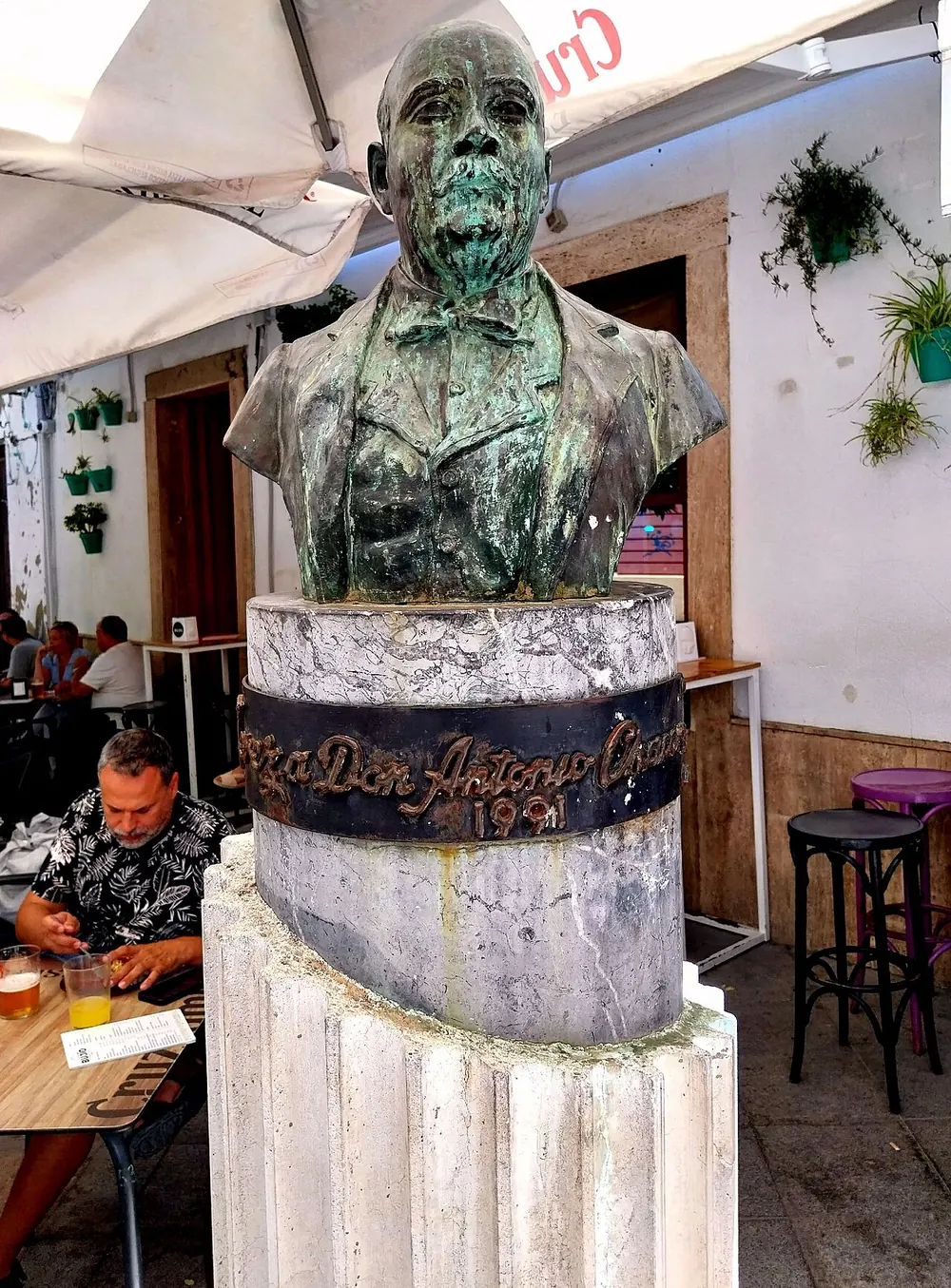
The venue's history says that in 1921 the owner offered the room to the Jerez singer Antonio Chacón and signed a contract tying him to it, with the Madrid guitarist Ramón Montoya alongside. Spanish Wikipedia says the owner persuaded Chacón to leave Los Gabrieles, an older Madrid flamenco room. The venue says he sang there until his death in 1929. That period lies behind the nickname Cathedral of Flamenco, which the venue and the tourism board both use. The guide to Chacón tells his story in full. Madrid's tourism board says the room has hosted many of flamenco's greatest artists over its more than hundred-year history, and the tablao's own pages list a long run of names.
Read next: Antonio Chacón and Villa Rosa
Guests, closures and a reopening
Madrid's tourism board says writers, actors and royalty came to the room, naming Ernest Hemingway, Ava Gardner, the bullfighter Luis Miguel Dominguín and King Alfonso XIII. Spanish Wikipedia treats the first three as certain and the king's visit as possibly legend. The tablao's own history says the room closed in 1963 and reopened a year later. Its pages name Lola Flores, Antonio Mairena, Paco de Lucía and Carmen Amaya among the artists who played the stage. The tablao's page on its secrets adds Audrey Hepburn among the Hollywood actresses drawn to flamenco and bullfighting, and says Ava Gardner included the room in her nights out in Madrid.
Nightclub years and the screen
Both the venue and Spanish Wikipedia say the room became a nightclub and party hall in the 1980s. The venue's account of those party-hall years includes Pedro Almodóvar's film High Heels, released in Spain in 1991, and says the director filmed a scene in the room in which the singer Miguel Bosé takes off a glove while Victoria Abril and Marisa Paredes watch. The tourism board adds that the architecture has made the tablao a favourite filming location. The venue says flamenco returned for three days a week from 2002 to 2009, while the room was still a party hall. The venue lists other films shot in the room, including a 1993 remake of La Lola se va a los puertos and Ocho apellidos catalanes in 2015.
Back to flamenco, and a new name
According to the venue, the room became a flamenco tablao exclusively again in 2011, after about a century of history, serving wine and Spanish dishes alongside daily shows. In 2022, two years after the pandemic closures, it reopened under the name Tablao Flamenco 1911, sponsored by the dancer Antonio Canales. Madrid's tourism board still lists Villa Rosa as the former name, which is why you will meet both names in articles and on old photographs. The sign over the door spells it Villarosa, as one word, which adds a third form to look out for. The booking calendar is the only reliable schedule for session times. The venue's site now describes a flamenco ensemble that renews itself each week, with guest artists on special programmes.
The oldest tablao in the world?
The venue calls itself the world's oldest tablao, and so does the booking page. It is the venue's own description, based on 1911 as the year the room opened. Wikipedia says tablao venues developed in the 1960s, replacing the earlier cafés cantantes, and the venue's own history begins its flamenco story with Chacón in 1921. Those facts can all be true together, because a room can be old and have changed what it was. Read the claim as the venue's account of its history. A separate guide on this site looks at what the word tablao means.
Read next: The world's oldest tablao?
Seeing the façade in person
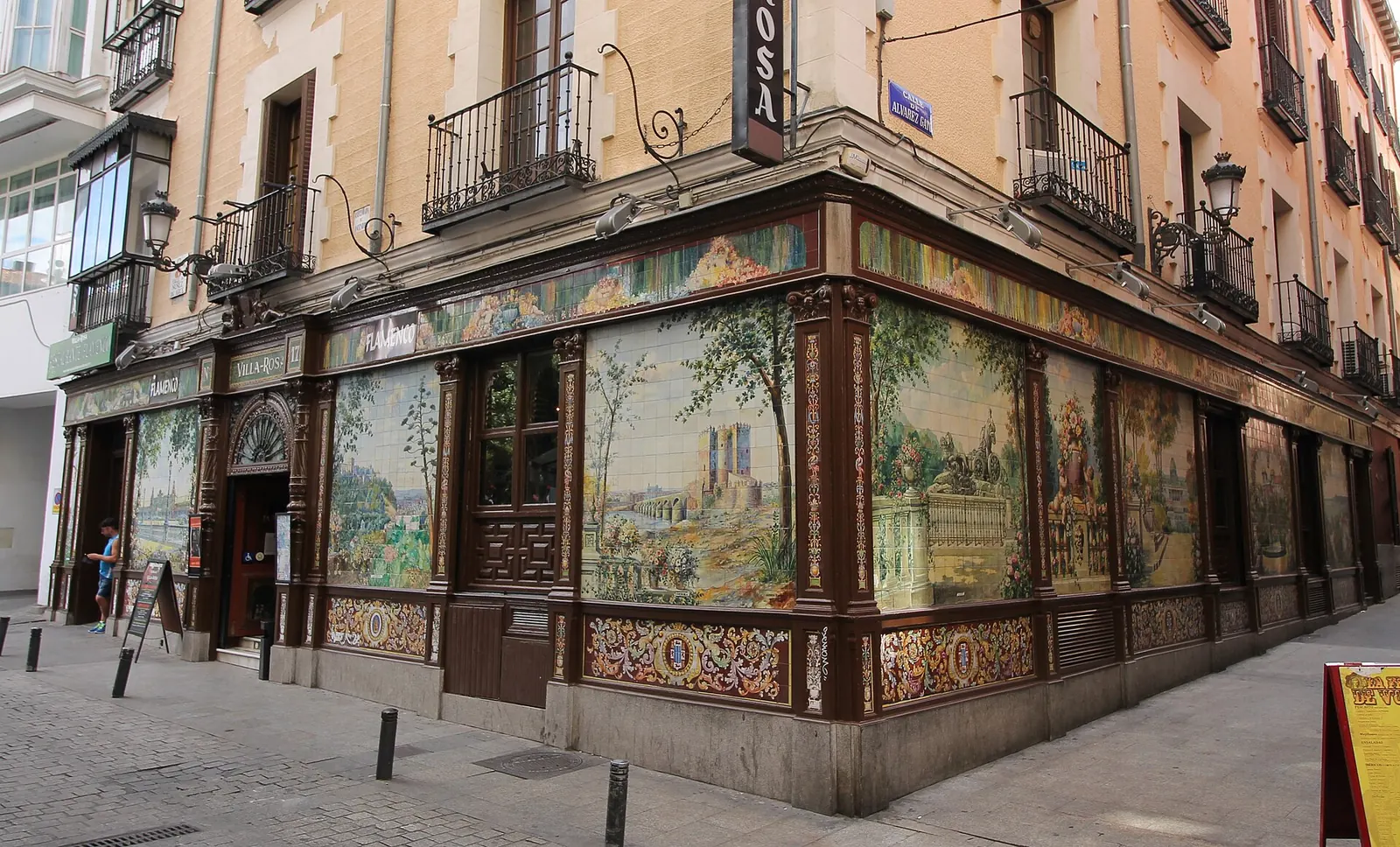
The ceramic panels wrap around the corner, so the best view comes from standing back on the plaza side and then following the wall along the side street. Daylight shows the colours of the glaze and the carved wooden frames around each panel. You do not need a ticket to look at the outside. The ticket buys the hour of flamenco and the drink inside the room, where the interior arches, ceiling and tiled walls are part of the setting. The tourism board describes the inside panels as scenes of daily life in Madrid, bullfighting and flamenco, and they have remained intact since they were made.
Who this isn't for
A single agreed account is not on offer here, because the sources differ on the date of the façade and on how the room's fortunes ran after 1964. Nor is this a substitute for the venue's own pages, which tell its story in its own words and are the right place to check any date you plan to repeat. Visitors who only want a quick photo of the tiles can do that from the plaza, and visitors who want to hear flamenco need a ticket. If you want to know what the room sounds like today, the guide to six flamenco forms on this site is a good place to start. Anyone planning a visit only for the history should also read the ticket guide first.
Frequently asked questions
Was the tablao called Villa Rosa?
Yes. Villa Rosa is the former name, and Madrid's tourism board still lists it. It reopened as Tablao Flamenco 1911 in 2022.
Who made the tiles on the façade?
The Sevillian artist Alfonso Romero Mesa, according to the venue and Madrid's tourism board. Sources date the work between 1915 and 1927.
What year did it open?
1911, according to the venue's history and Spanish Wikipedia, as a fried-food and tapas bar run by three men from the bullring.
Who was Antonio Chacón?
A flamenco singer from Jerez, born in 1869 and dead in Madrid in 1929. The venue says he signed with the room in 1921.
Can I see the façade without a ticket?
Yes. The tiled front faces Plaza de Santa Ana and the side street. A ticket buys the show and drink inside.
Sources